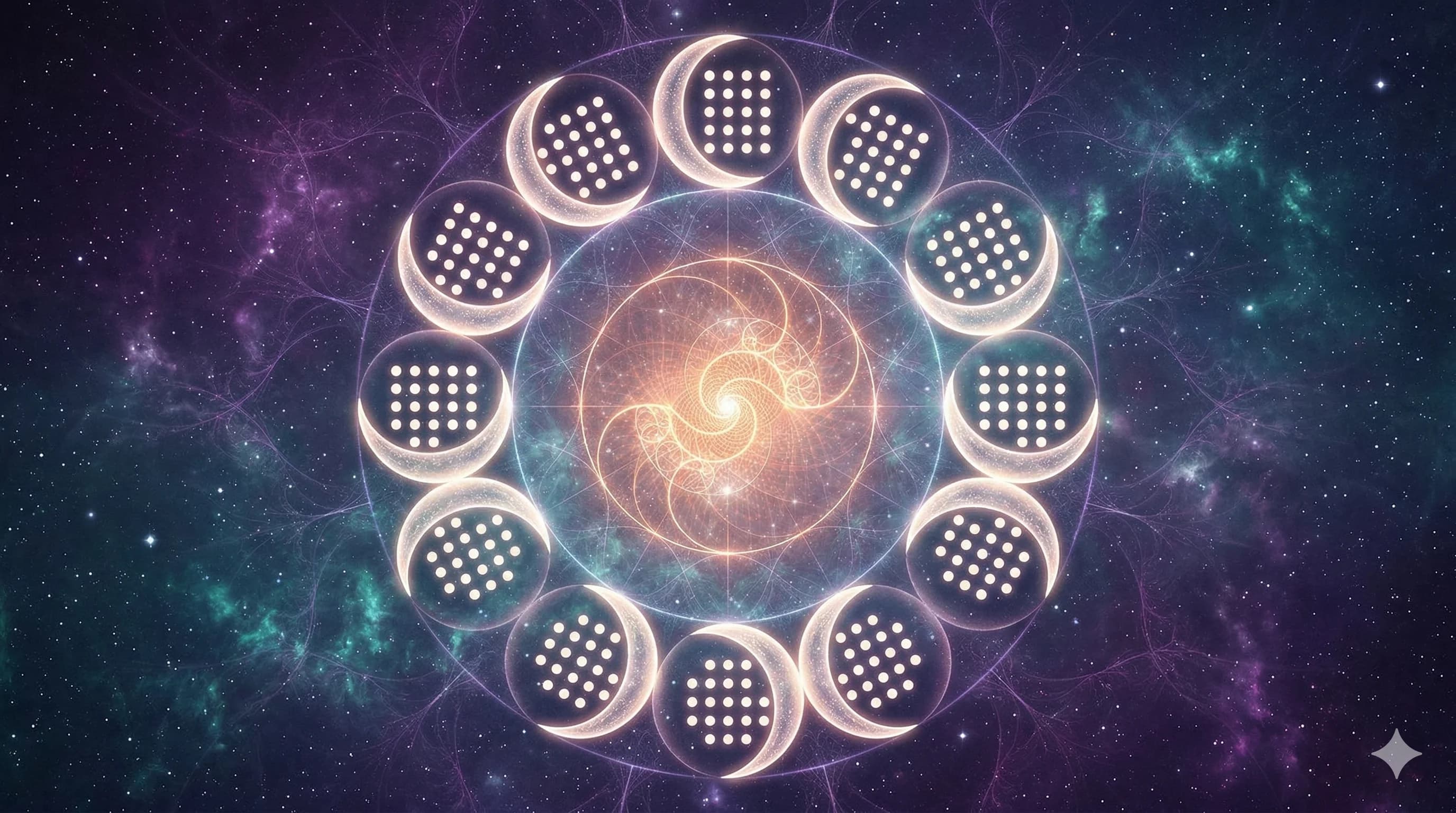
The Mathematical Harmony of 13 x 28: Why Perfect Symmetry Changes How You Experience Time
What if the calendar on your wall was not just irregular, but mathematically broken?
Think about it: months of 28, 29, 30, and 31 days. Quarters that never balance. A system so uneven that entire industries exist just to help us schedule around its quirks. The Gregorian calendar, for all its historical significance, is a patchwork of political compromises and astronomical approximations.
Now imagine a calendar where every month is identical. Where every week falls on the same dates, month after month, year after year. Where the math is so clean that you could predict any day's position in your head.
That is the promise of 13 x 28 — the mathematical backbone of the 13 Moon Calendar. In this article, we will explore the elegant arithmetic behind this system, compare it to the Gregorian calendar's irregularities, and examine how these patterns connect to deeper cycles like the Tzolkin.
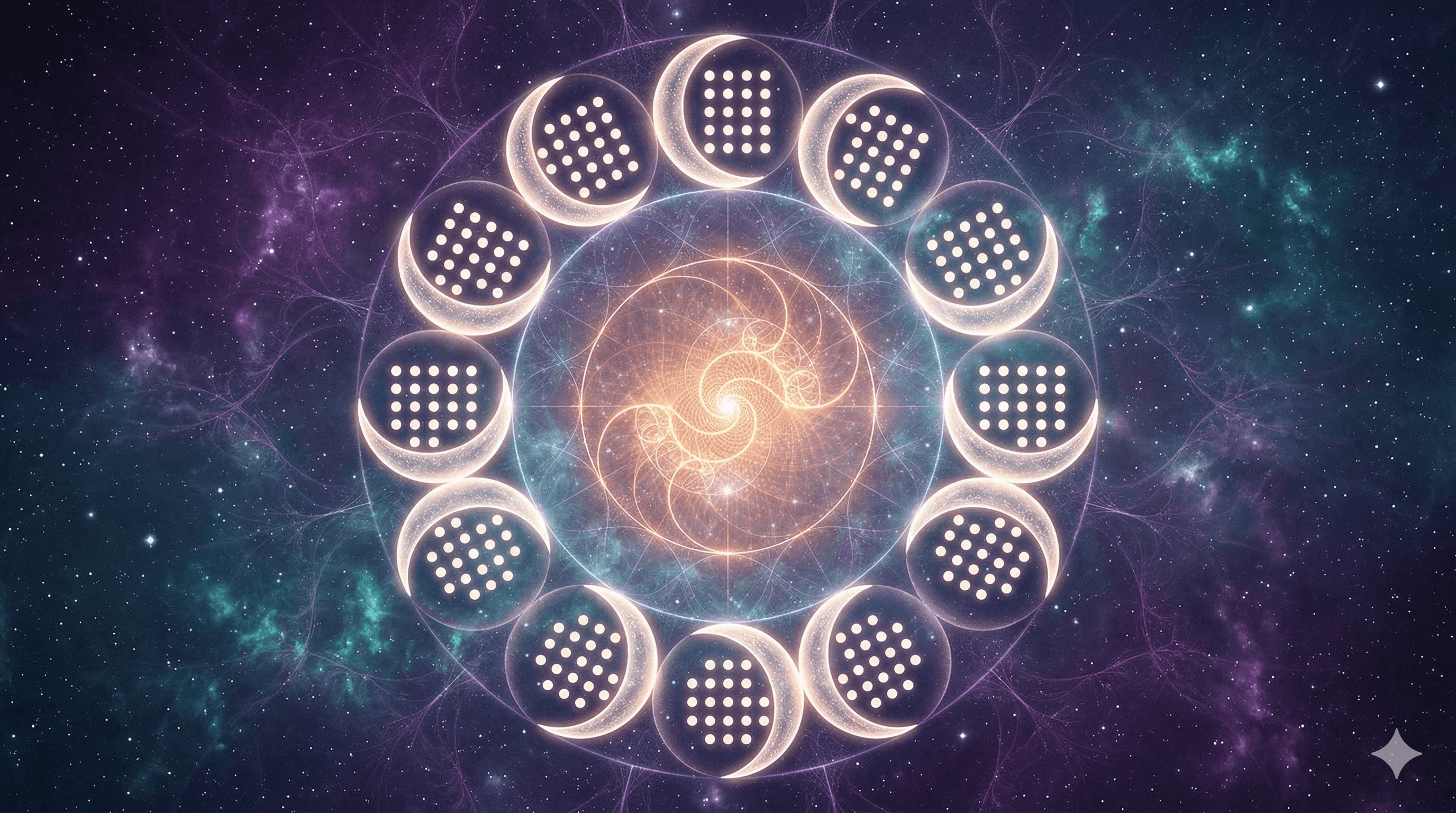
The Gregorian Problem: A Calendar Built on Compromise
The Gregorian calendar, introduced by Pope Gregory XIII in 1582, was designed to correct the drift of the Julian calendar relative to the spring equinox. It succeeded astronomically — but at the cost of mathematical elegance.
Consider these irregularities:
- Unequal months: Months range from 28 to 31 days. February has 28 (or 29), while January has 31. There is no pattern to memorize without a mnemonic.
- Uneven quarters: Q1 has 90 days (or 91 in leap years), Q2 has 91, Q3 has 92, and Q4 has 92. Businesses spend significant resources normalizing these differences.
- Shifting weekdays: The first day of each month falls on a different day of the week. Planning requires a fresh calendar every year.
- Leap year complexity: A year is a leap year if divisible by 4, except centuries, unless also divisible by 400. This rule alone reveals the system's patchwork nature.
None of this is accidental. The Gregorian calendar was optimized for astronomical accuracy (keeping Easter near the spring equinox), not for human usability. The result is a tool that tracks the Earth's orbit well but creates constant friction in daily life.
The Elegance of 13 x 28
The 13 Moon Calendar takes a radically different approach. Instead of fitting months around astronomical events, it begins with a simple equation:
13 months x 28 days = 364 days + 1 Day Out of Time = 365 days
This single formula produces a cascade of harmonious properties:
1. Perfect Weekly Alignment
Because 28 is exactly divisible by 7, every month contains exactly 4 weeks. The first day of every month always falls on the same weekday. If Moon 1, Day 1 is a Sunday, then Moon 2, Day 1 is also a Sunday — and so is Moon 13, Day 1.
2. Perpetual Calendar
This weekly alignment means you only need one calendar template for every month, every year. There is no need to print new calendars annually. The pattern is perpetual.
3. Equal Months
Every month has exactly 28 days. No month is longer or shorter. Monthly comparisons — whether for budgeting, habit tracking, or project planning — become perfectly apples-to-apples.
4. Balanced Quarters
While 13 does not divide evenly into 4 quarters, the 13 Moon system organizes itself into 4 castles of 65 days each (260 total in the Tzolkin cycle). Within the 364-day year, you can also group moons into roughly equal segments for planning purposes — something impossible with 12 months of unequal length.
Side-by-Side Comparison
Here is how the two systems compare on key mathematical properties:
| Property | Gregorian Calendar | 13 Moon Calendar |
|---|---|---|
| Number of months | 12 | 13 |
| Days per month | 28, 29, 30, or 31 | 28 (always) |
| Weeks per month | 4 to 4.43 | Exactly 4 |
| Same weekday each month? | No | Yes |
| Perpetual (reusable yearly)? | No | Yes |
| Extra day(s) | Leap day (Feb 29) | Day Out of Time (July 25) |
| Tracks lunar phases? | No | Symbolic only (not astronomical) |
Deeper Patterns: Fractals and the Tzolkin Connection
The beauty of 13 x 28 extends beyond simple monthly regularity. The numbers 13 and 28 participate in a web of mathematical relationships that practitioners find deeply meaningful.
The Fractal of 7
The number 28 is the second perfect number in mathematics (its divisors 1 + 2 + 4 + 7 + 14 = 28). It is also 7 x 4. The 7-day week, a cycle with roots in ancient Babylon, nests perfectly inside the 28-day moon. This creates a fractal-like structure: 7 days in a week, 4 weeks in a moon, 13 moons in a year.
Connection to the Tzolkin
The Dreamspell system also uses a 260-day cycle called the Tzolkin, which is the product of 13 Galactic Tones x 20 Solar Seals. Notice the number 13 appearing again. In the Dreamspell framework, these two cycles — the 365-day solar year and the 260-day Tzolkin — interlock like gears, creating a combined cycle of 18,980 days (approximately 52 years) before any given combination of date and Kin repeats.
This interlocking is made possible because both systems share the number 13 as a fundamental building block. The 13 Moon Calendar has 13 months; the Tzolkin has 13 tones. This shared factor creates resonance between the daily and yearly scales.
Harmonic Numbers
Practitioners of the Dreamspell system, created by Jose Arguelles, often point to the harmonic properties of these numbers: 4, 7, 13, 20, 28, 52, 91, 260, 364. Each one is a multiple or factor of another, creating a self-referencing numeric system. Whether you see this as meaningful cosmology or elegant numerology is a personal choice — but the mathematical consistency is real.
How Mathematical Symmetry Changes Daily Life
Theory is interesting, but does the symmetry of 13 x 28 actually matter in practice? Advocates say yes, and here is why:
Simplified Planning
When every month has the same structure, recurring events become effortless. A meeting on Day 7 of every Moon always falls on the same weekday. Billing cycles, habit trackers, and project milestones align naturally without adjustment.
Rhythmic Living
Many users report that the regularity of 28-day cycles helps them develop a stronger sense of rhythm in their lives. Instead of the stop-start feeling of irregular months (is February over already?), each Moon feels like a complete, contained unit.
Reduced Cognitive Load
There is no need to remember which months have 30 or 31 days. No need for the "thirty days hath September" rhyme. The mental overhead of the calendar simply disappears.
The Day Out of Time
The 365th day — the Day Out of Time (July 25) — is not assigned to any month or any week. It exists outside the 13 x 28 grid as a day of celebration, reflection, and release. Rather than being a flaw, this "extra" day is treated as a feature: a pause before the new year begins on July 26.
An Important Clarification: Symbolic, Not Astronomical
It is essential to be clear about what the 28-day cycle is and is not.
The word "Moon" in the 13 Moon Calendar can be misleading. The actual synodic lunar month — the time between two identical moon phases — is approximately 29.53 days, not 28. The sidereal lunar month (the moon's orbital period relative to the stars) is about 27.32 days.
The 28-day cycle used in this calendar is symbolic and mathematical, not astronomical. It was chosen because:
- 28 divides evenly by 7, creating perfect weeks
- 13 x 28 + 1 = 365, matching the solar year
- 28 is a rough approximation of the lunar cycle (though not exact)
- 28 is a perfect number, which carries mathematical significance
If you are looking for a calendar that precisely tracks the phases of the moon, you would need a lunisolar system like the Hebrew or Islamic calendars. The 13 Moon Calendar is better understood as a solar calendar with a rhythmic, symbolic month structure inspired by — but not tied to — the moon's actual cycle.
Additionally, the 13 Moon Calendar as used today is part of the Dreamspell system created by Jose Arguelles in the 1990s. It is a modern tool for mindfulness and personal synchronization, not an ancient Maya artifact. The traditional Maya used the Tzolk'in (260 days) and Haab (365 days with 18 months of 20 days + 5 Wayeb days) — structurally different systems.
Frequently Asked Questions
Does the 13 Moon Calendar track the actual phases of the moon?
No. The 28-day "Moon" is a symbolic, mathematical unit. The real lunar cycle is approximately 29.53 days. The 13 Moon Calendar is fundamentally a solar calendar (365 days) organized into equal, rhythmic segments.
How are leap years handled?
In leap years, a second Day Out of Time is added. The 13 x 28 grid remains untouched — the extra day simply extends the pause between years. This preserves the perpetual calendar property.
Is 13 x 28 the same as the ancient Maya calendar?
No. The ancient Maya used the Tzolk'in (260 days) and Haab (365 days divided into 18 months of 20 days plus a 5-day Wayeb period). The 13 x 28 structure is part of the modern Dreamspell system created by Jose Arguelles, inspired by but distinct from Maya timekeeping.
Why 13 and not 12?
The number 12 does not divide 365 into equal whole-number months with complete weeks. 12 x 30 = 360, leaving 5 leftover days. 13 x 28 = 364, leaving only 1 day — the Day Out of Time. The number 13 also resonates with the 13 Galactic Tones of the Tzolkin cycle in the Dreamspell system.
Can I use the 13 Moon Calendar alongside the Gregorian calendar?
Absolutely. Most practitioners use both systems simultaneously. The 13 Moon Calendar serves as a reflective, rhythmic overlay on top of the Gregorian dates you need for work, appointments, and social coordination.
Conclusion: Symmetry as a Way of Living
The mathematical harmony of 13 x 28 is not just a curiosity — it is an invitation to rethink your relationship with time. Where the Gregorian calendar forces you to adapt to its irregularities, the 13 Moon Calendar offers a structure that adapts to you.
Equal months. Perpetual weeks. A clean, fractal architecture of 7, 28, and 364. Whether you adopt it as your primary timekeeping system or simply use it as a mindfulness tool, the symmetry of 13 x 28 has the power to bring more rhythm, clarity, and harmony to your daily experience.
The numbers do not lie. 13 x 28 + 1 = 365. Perfect time.
Ready to experience mathematical harmony in your daily life? Explore the 13 Moon Calendar on our interactive tool. Try tracking your weeks and months using the 28-day cycle for one full Moon and notice the difference. Share your experience in the comments below.